PLATO++: Pose-Conditioned Part-Aware Object Generation via Residual Structure Learning
IEEE/CVF CVPR Workshops 2026, Workshop on AI for Creative Visual Content Generation, Editing and Understanding (CVEU), pp. 6012-6021
I am a Computer Science undergraduate at IISER Bhopal, working in computer vision research. My interests sit around Generative Image Synthesis, Image Editing, Representation Learning, and the Mechanistic Interpretability of generative models.
Most of my work so far has been with Diffusion and Flow Matching Models, particularly score-based and SDE formulations, Conditional Flow Matching, and Latent Diffusion. I tend to build these systems end to end from scratch, because that is the only reliable way I have found to understand their training dynamics, conditioning, controllability, and failure modes.
A growing part of my work is interpreting what generative models learn. I use Sparse Autoencoders, CrossCoders, and probing techniques to read and steer internal representations. At CVIT, IIIT-H I studied how structured part-level conditioning shapes layout and image generation, and at Spectrum Lab, IISc Bengaluru I work on controllable flow-matching synthesis of medical imagery paired with its annotations.
Lately I have been pulled toward the interpretability of world models, and one question in particular: when a video model appears to understand how the physical world behaves, is that understanding actually represented somewhere inside it, and in what form? Physics is an unusually good testbed for this, since it is one of the few concepts where the ground truth is exact and you can check your answer.
I am actively looking for research opportunities in Generative Vision and Interpretability.
IEEE/CVF CVPR Workshops 2026, Workshop on AI for Creative Visual Content Generation, Editing and Understanding (CVEU), pp. 6012-6021
Manuscript in preparation
Advisor: Prof. Chandra Sekhar Seelamantula
Advisor: Prof. Ravi Kiran Sarvadevabhatla
INTEREST Fellowship · Supervisor: Sergey Dmitrievsky
Suppressed unsafe visual concepts in Stable Diffusion 1.4 at inference time using sparse dictionary learning, with no retraining of the diffusion model. I trained a K-Sparse Autoencoder and a CrossCoder on CLIP text-encoder activations, found the concept-aligned directions, and subtracted them through forward hooks amplified by CFG. Steering across CLIP layers 4, 8 and 9 cut the nudity rate from 55.0% to 5.0%, against 11.2% for single-layer SAE steering.
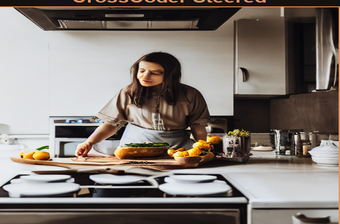
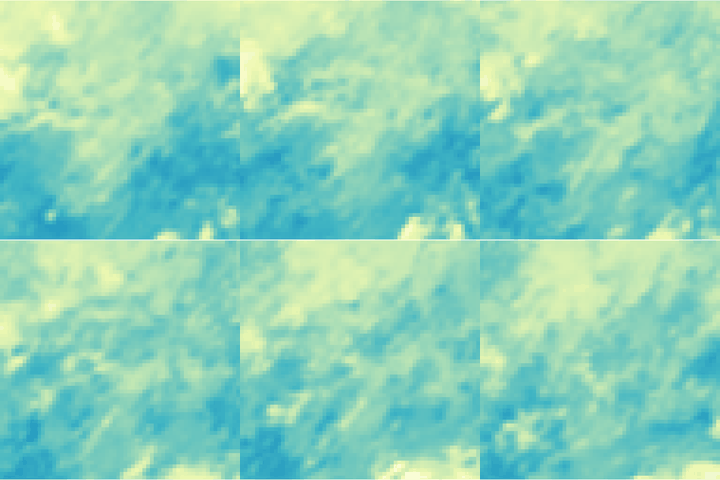
A two-stage CorrDiff pipeline for cloud nowcasting on ISRO INSAT-3DR imagery. An MSE base U-Net supplies a stable but blurry forecast, and a diffusion model paints in the residual detail. Conditioning the base model on optical flow and diurnal phase eliminated the generative collapse that sank plain diffusion in autoregressive rollout, and got the model modelling cloud dissipation over a 3-hour horizon.
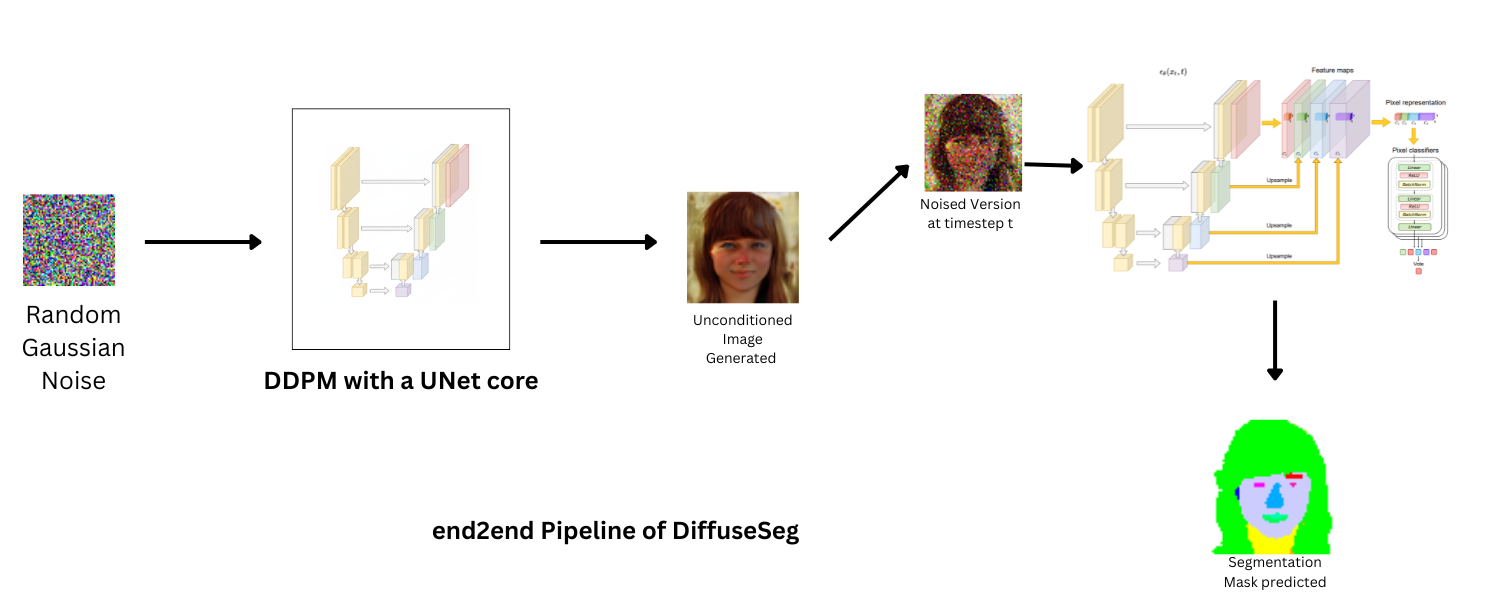
Reused frozen DDPM U-Net multi-scale features for dense prediction, with no task-specific backbone training at all. Lightweight pixel-wise segmentation heads on the diffusion decoder features reach mIoU above 0.35 on CelebA-HQ from only 100 labelled images, which turns one generative model into a labelled-data factory. Trained models, synthetic datasets and reproducible scripts are all released.
Optimal-Transport Conditional Flow Matching implemented from scratch on CelebA-HQ 64×64, learning straight-path velocity fields between noise and data for fast ODE sampling. Two interchangeable backbones, a UNet and a DiT-S/4 with adaLN time conditioning, plus Euler and second-order Heun solvers. Heun reaches comparable visual quality at fewer function evaluations.
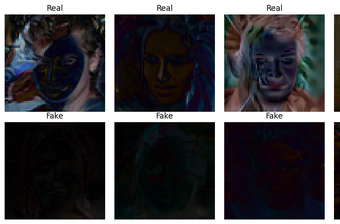
DDIM inversion plus reconstruction error, used as an engineered feature for telling real photographs from AI-generated ones. A diffusion model reconstructs its own samples almost perfectly and real photographs poorly, so PCA of the resulting error maps is near-linearly separable and a 3-block CNN trained from scratch reaches 96.65% test accuracy.
A DDPM built from scratch to generate high quality strong gravitational lensing imagery, paired with a deep residual classifier that sorts lensing images into three substructure categories. This was my first end-to-end diffusion project, an early exploration of whether generative models could stand in for expensive physical simulation in astrophysics.

I quiz. I previously led the IISER Bhopal Quiz Club (IBQC), where we run quizzes every Saturday night on anything from historical art to internet culture, and compete at Inter IISER festivals. I also built and help maintain the club's website at ibqc.vercel.app.

Posts and write-ups are on the way. I plan to write about mechanistic interpretability of Diffusion Models, Flow Matching from first principles, and experiments from my research.