Project · Generative Model Forensics
Deepfake Detection via Diffusion Reconstruction Error
Using a diffusion model's own inversion error as an engineered feature that turns a hard non-linear problem into a nearly linearly separable one
IISER Bhopal · Nov 2025
Overview
A diffusion model reconstructs its own outputs far better than it reconstructs the real world. That asymmetry is the detection signal, and it is strong enough that most of the work goes into the feature rather than the classifier.
The core hypothesis, following DIRE[1], is that a partially-trained, "brittle" diffusion model can faithfully reconstruct images it generated itself, but will fail on real images that lie outside its learned manifold. The DIffusion Reconstruction Error (DIRE) exploits that failure directly: invert an image to its latent, sample back, and take the per-pixel absolute difference.
on 2,000 held-out images
from scratch
5k real / 5k generated
The DIRE Signal
For an image x₀, the DIRE map is the per-pixel absolute error between the image and its
reconstruction after a full inversion-and-sampling cycle:
D(x₀) = | x₀ − x₀^recon |-
Inversion (0 → T). The image is deterministically inverted through the DDIM[3]
process (100 steps) to recover its corresponding latent
x_T. DDIM's determinism is what makes this well-defined. A stochastic sampler would inject noise into the round trip and destroy the signal. -
Reconstruction (T → 0). That latent is sampled back to an image with
deterministic DDIM (
η = 0). - Difference. The absolute per-pixel error becomes a new 64×64×3 image.
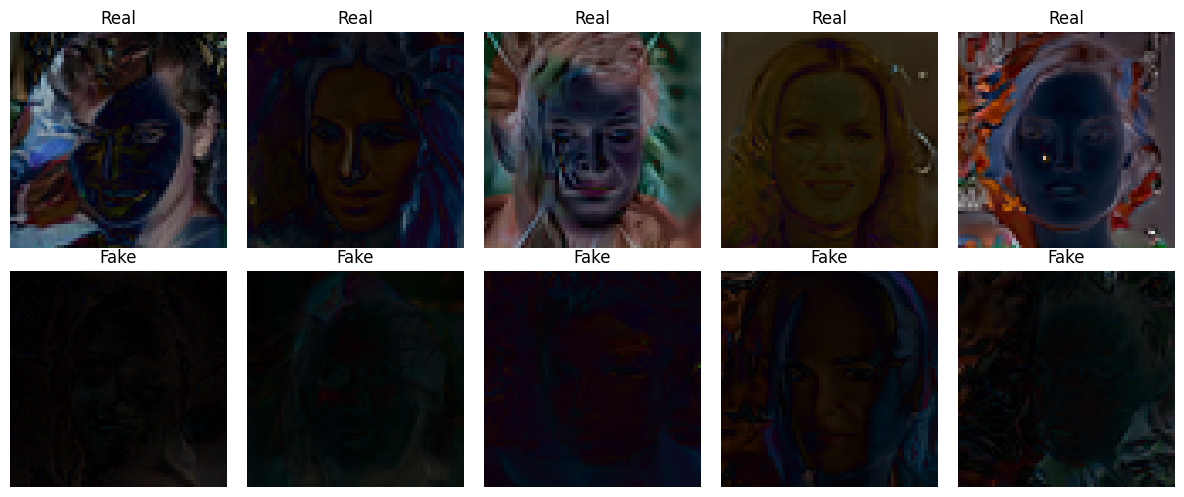
Real faces come back with high, structured error, giving bright maps. Faces generated by the same DDPM come back with near-zero error, giving almost black maps.
Data
Why This Works: The EDA
Before building any classifier, the exploratory analysis had already made the case. Pixel-intensity histograms of raw real vs. generated faces overlap almost perfectly, so global colour and brightness statistics carry essentially no signal. On DIRE maps the same histograms separate cleanly, with real images concentrated at high error and generated images decaying exponentially toward zero.
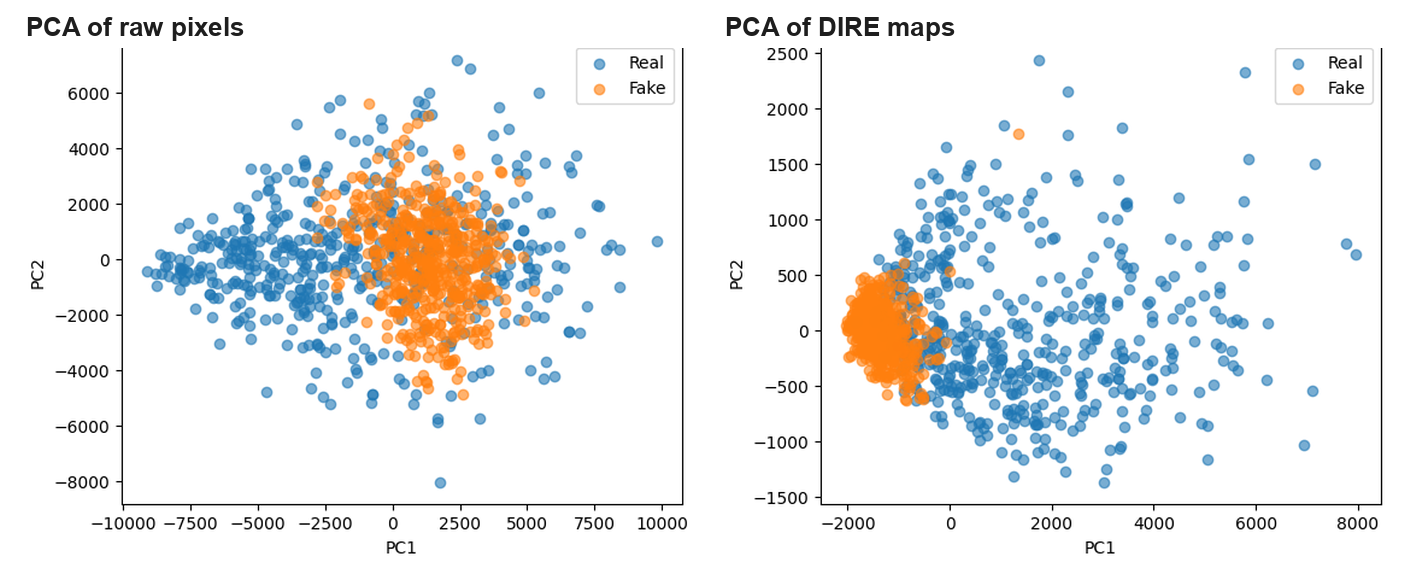
PCA makes it starker. Projected onto their first two principal components, raw images form one overlapping blob: the real/fake distinction is real but highly non-linear and subtle. The same projection on DIRE maps shows remarkable near-linear separability.
Results
The DireClassifier: three conv/batchnorm/pool blocks (16 → 32 → 64 channels) into a
256-unit FC layer with dropout, was trained from scratch with BCEWithLogitsLoss and
Adam. Validation accuracy held steadily in the 95–97% range with no significant overfitting.
| Class | Precision | Recall | F1 | Support |
|---|---|---|---|---|
| Real | 0.96 | 0.98 | 0.97 | 1000 |
| Generated | 0.98 | 0.95 | 0.97 | 1000 |
| Overall accuracy | 96.65% | 2000 | ||
Confusion matrix: 979 true negatives and 21 false positives on real images; 954 true positives and 46 false negatives on generated ones, which is balanced performance across both classes.
Limitations
Two problems are intrinsic to the approach, and both matter more than the headline accuracy:
- The detector needs a mediocre generator. The signal exists because the reference DDPM is imperfect. A fully converged model that generates faces perfectly would reconstruct real images well too, and the DIRE maps would stop being distinguishable. So the method gets weaker as generators get better.
- Poor cross-generator transfer. Images produced by a model other than the one used to construct the DIRE maps are frequently misclassified. The feature encodes distance from one specific model's manifold, not a universal "syntheticness".
Future work would start with augmentation applied to the DIRE maps themselves (flips, rotations) to stabilise validation and reduce the minor overfitting observed.
References
- Z. He, et al. DIRE: Diffusion-based Representation for Deepfake Detection. ICCV, 2023.
- J. Ho, A. Jain, P. Abbeel. Denoising Diffusion Probabilistic Models. NeurIPS, 2020.
- J. Song, C. Meng, S. Ermon. Denoising Diffusion Implicit Models (DDIM). ICLR, 2021.
- Z. Liu, P. Luo, X. Wang, X. Tang. Deep Learning Face Attributes in the Wild (CelebA). ICCV, 2015.