Project · Generative Representation Learning
DiffuseSeg
Synthetic data and semantic segmentation from a single diffusion model, turning one DDPM into a labelled-data factory
Overview
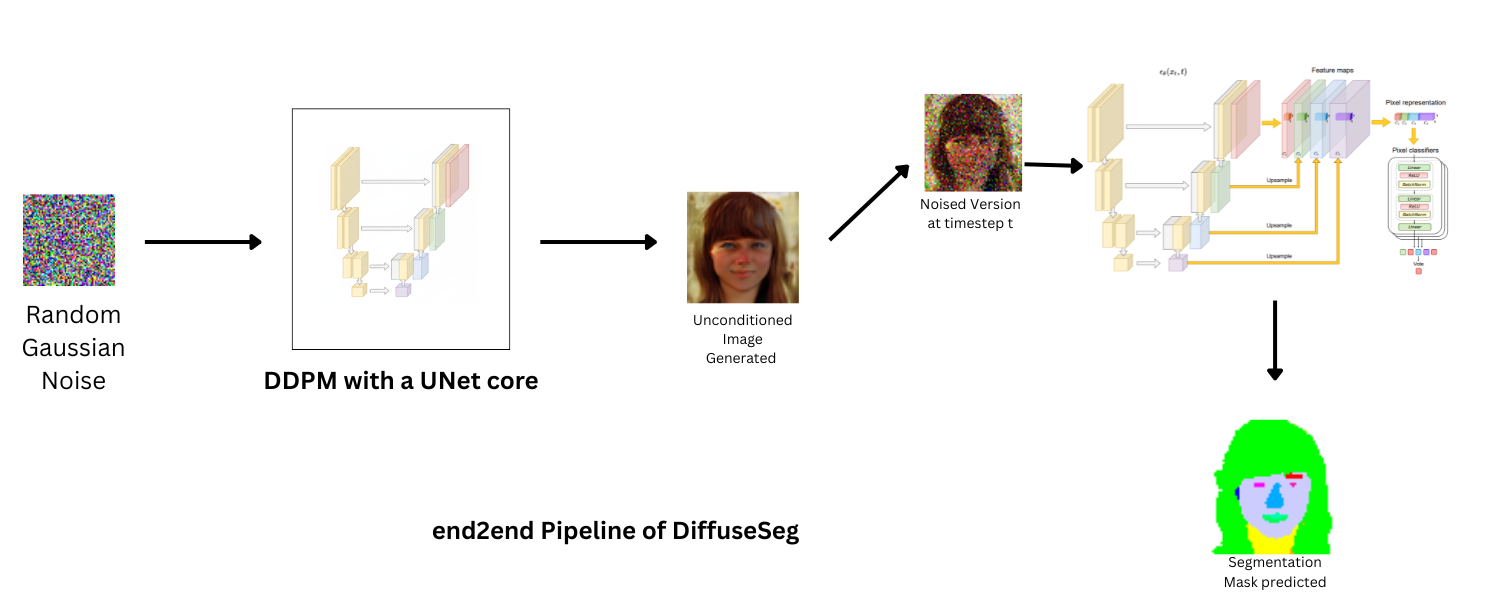
A diffusion model learns a lot about image structure while it is being trained to generate. DiffuseSeg reuses that instead of discarding it after sampling: the same features that let a DDPM draw a face also let it parse one.
An unconditionally trained DDPM[1] serves as a backbone for both high-fidelity image synthesis and label-efficient semantic segmentation. By extracting the rich multi-scale features from its U-Net decoder, a lightweight pixel-level segmentation head can be trained with very few labelled examples, effectively converting the generative model into a source of paired images and annotations.
CelebA-HQ
needed to train the head
trained for segmentation
The approach was inspired by Baranchuk et al.[2], who showed that diffusion features support label-efficient segmentation.
The Two-Stage Pipeline
Stage 1: Train an unconditional DDPM
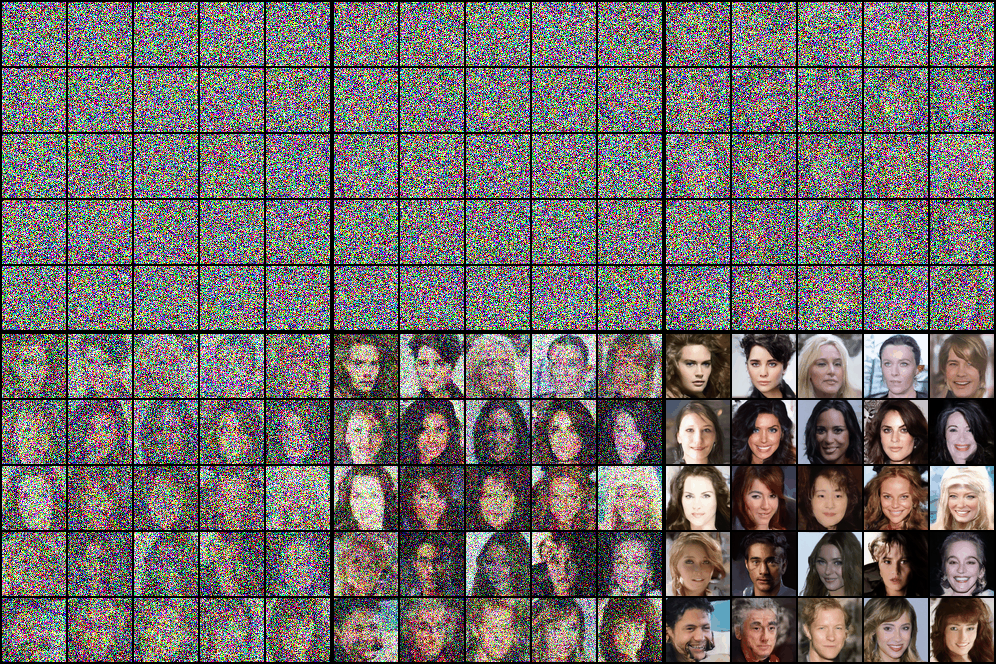
A DDPM with a U-Net core is trained from scratch on unlabelled face images (CelebA-HQ[3] at 64×64), learning to reverse a diffusion process that turns Gaussian noise into a realistic face. The training scripts generalise to any dataset with minor dataset-specific configuration changes, or you can skip straight to stage 2 with a pretrained model.
Stage 2: Train a segmentation head on frozen features
With the DDPM U-Net frozen, it becomes a pure feature extractor:
- Feature extraction: for a given image (real or synthetic), activations are pulled from specific decoder blocks of the U-Net at selected timesteps (t = 50, 150, 250). The choice of all up-blocks and these timesteps was motivated by the source paper[2] and the architecture used here.
- Pixel descriptors: the multi-scale feature maps are upsampled to a common resolution and concatenated, giving every pixel one rich feature vector.
- MLP ensemble: an ensemble of small pixel-wise MLPs is trained on a handful of labelled images to classify each pixel descriptor into a semantic class (hair, skin, nose, …).
Results
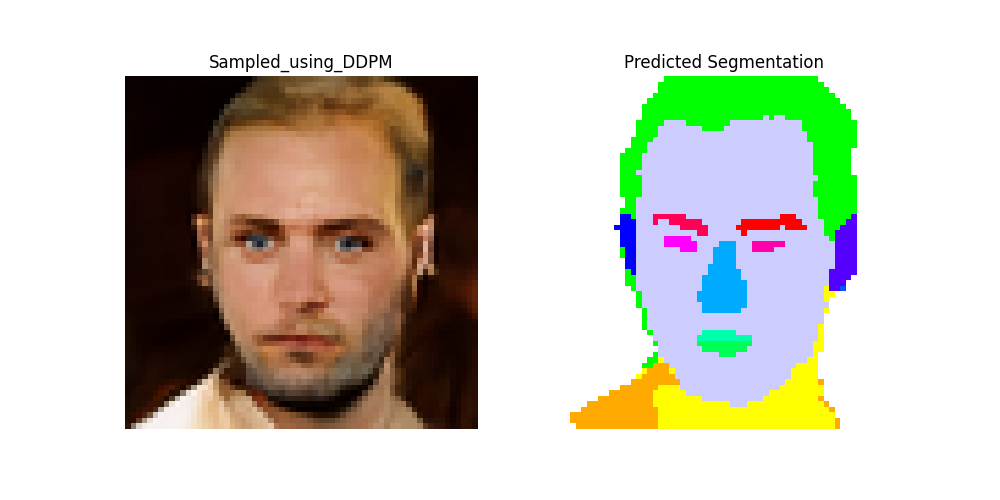
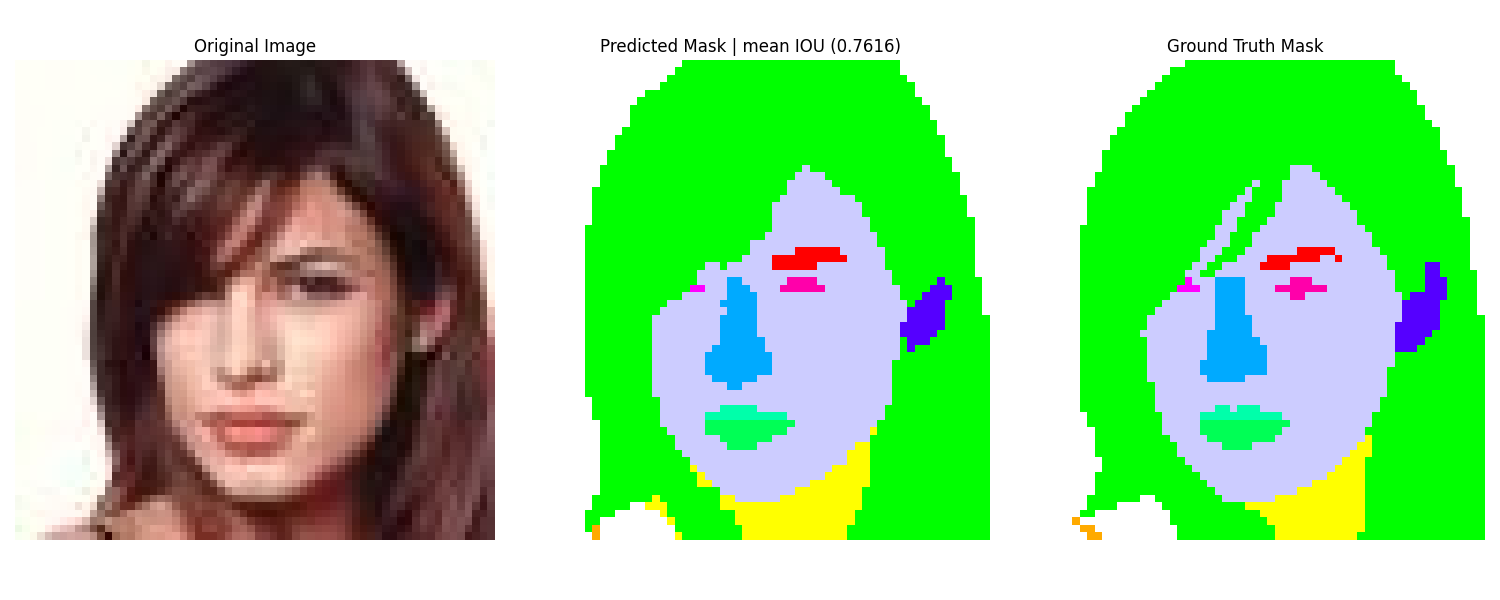
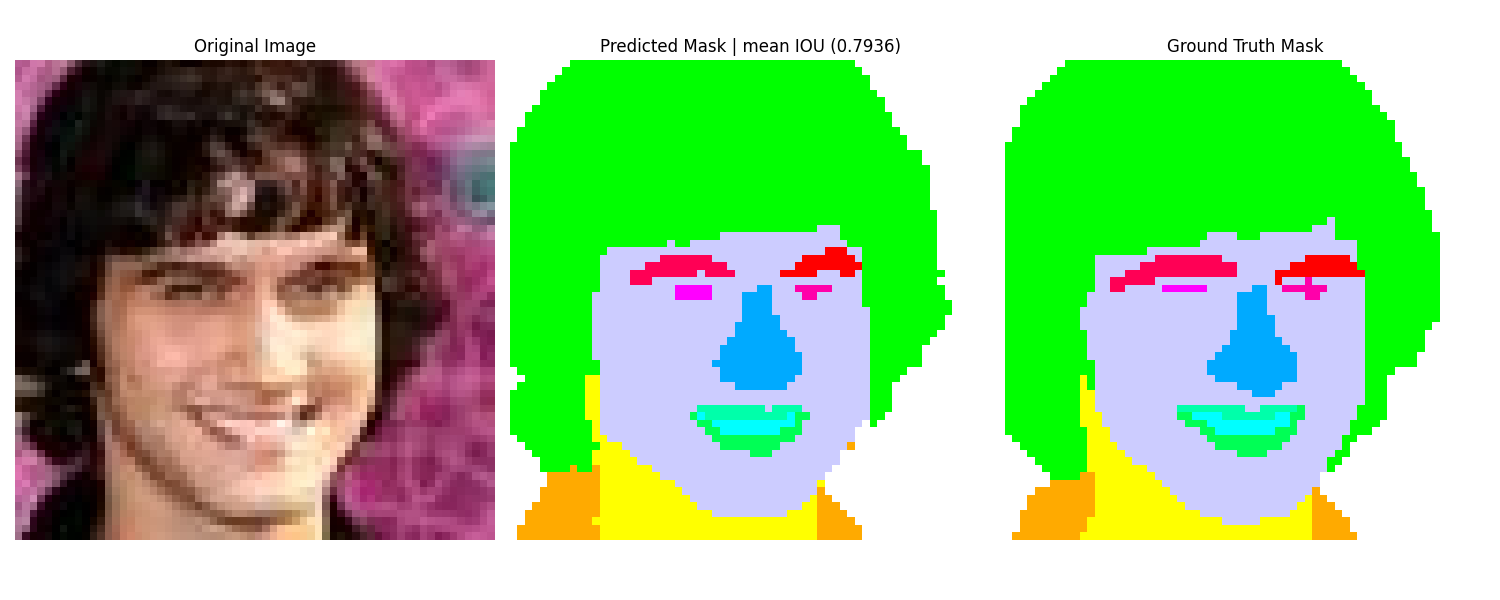
The segmentation head performs well on the CelebA-HQ validation set. That is itself a sign that the frozen diffusion features are semantically organised, since a nearly linear probe would not work otherwise.
End-to-end generation
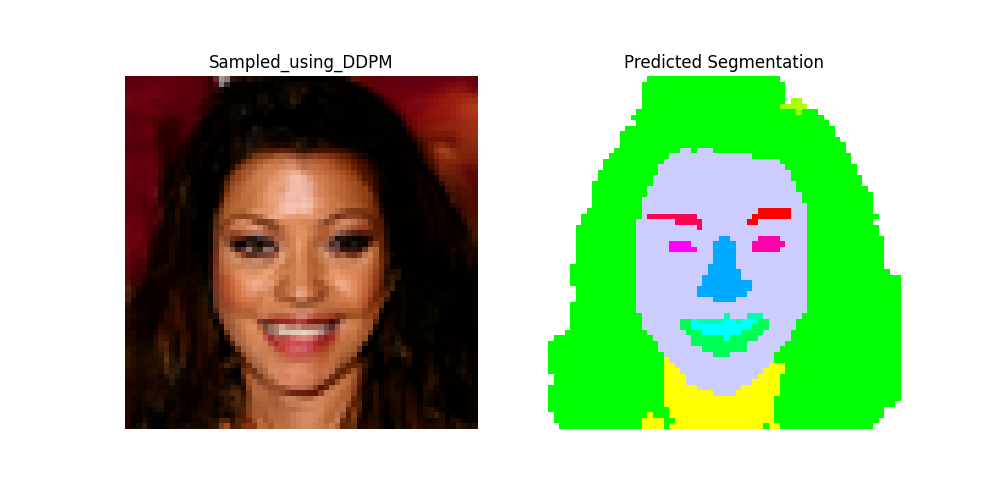
A synthetic image produced by the DDPM, alongside the segmentation map produced by the MLP head:
Validation on real images
Released Artefacts
- Colab notebook: run the pipeline end to end.
- Synthetic dataset: image/mask pairs on Hugging Face.
- DDPM weights: trained on resized CelebA-HQ 256 → here.
- Segmentation head weights: here.
References
- J. Ho, A. Jain, P. Abbeel. Denoising Diffusion Probabilistic Models. NeurIPS, 2020.
- D. Baranchuk, I. Rubachev, A. Voynov, V. Khrulkov, A. Babenko. Label-Efficient Semantic Segmentation with Diffusion Models. ICLR, 2022.
- Z. Liu, P. Luo, X. Wang, X. Tang. Deep Learning Face Attributes in the Wild (CelebA-HQ). ICCV, 2015.