INTEREST Fellowship · JINR, Dubna
Deep Learning for OPERA Neutrino Events
CNN-based analysis of detector data from the OPERA neutrino experiment, plus a browser-based 3D event visualiser
Dzhelepov Laboratory of Nuclear Problems, Joint Institute for Nuclear Research, Dubna · Supervisor: Sergey Dmitrievsky
February to April 2025
Overview
OPERA was built to catch a rare event: a muon neutrino oscillating into a tau neutrino over the 730 km between CERN and Gran Sasso. Rare signals come with a lot of background, which makes it a classification problem.
Selected for the INTEREST Fellowship at JINR Dubna, I worked on applying convolutional neural networks to detector image data from OPERA, and built a visualisation tool for inspecting individual neutrino events in three dimensions.
Work
CNN classification of detector events
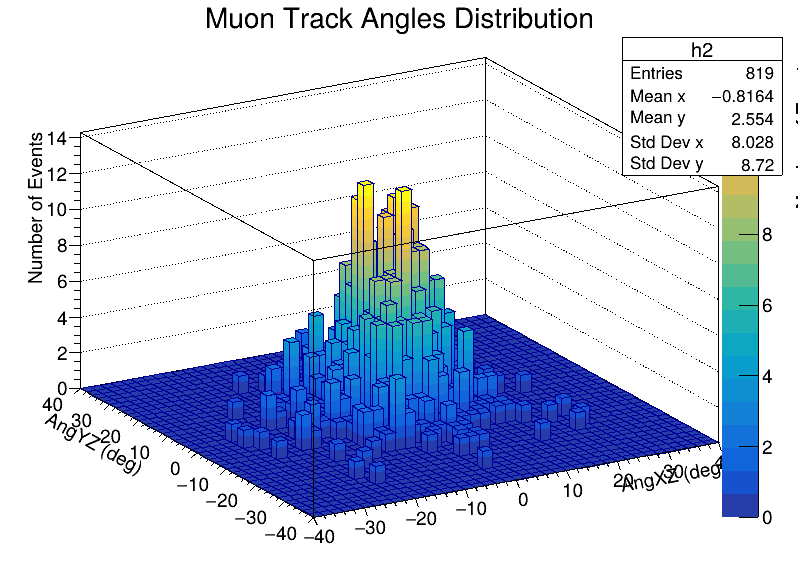
Detector readouts were treated as images and passed to convolutional classifiers to distinguish event types. The architecture was not the hard part. The data is a sparse, structured physical readout that only looks like an image, so a CNN's inductive biases fit it only partly and the preprocessing choices end up mattering more than the model.
3D event visualisation
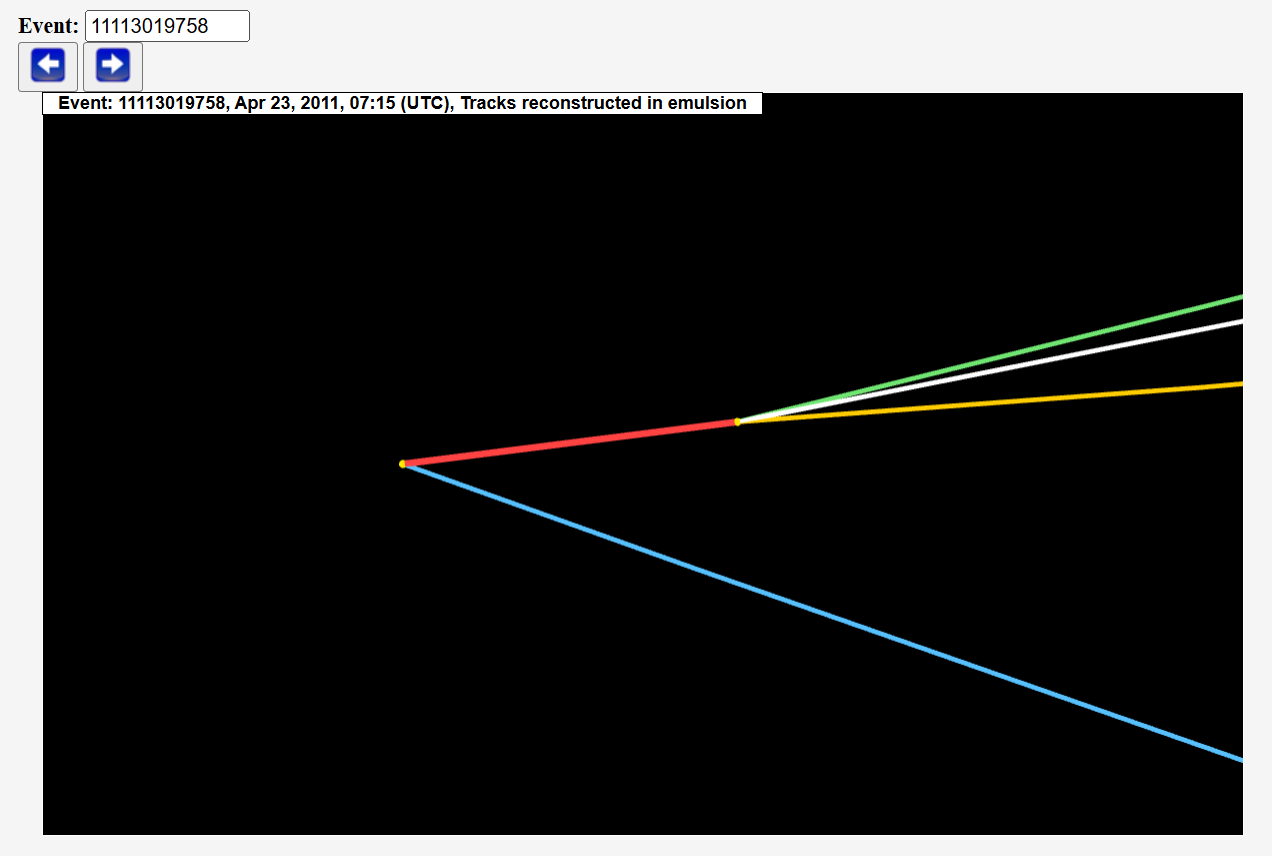
I built a browser-based tool for inspecting neutrino and muon track events in 3D, letting individual events be rotated and stepped through, which was useful both for physical intuition and for eyeballing what the classifier was actually being shown.
References
- N. Agafonova, et al. (OPERA Collaboration). Discovery of tau neutrino appearance in the CNGS neutrino beam with the OPERA experiment. Physical Review Letters, 115:121802, 2015.
- R. Acquafredda, et al. (OPERA Collaboration). The OPERA experiment in the CERN to Gran Sasso neutrino beam. Journal of Instrumentation, 4:P04018, 2009.